Why Some Designs Keep Their Signal
Rolls-Royce, Ferrari, classic clothing, platform engineering, and the slow variables underneath taste.
I was sitting outside in the LA sun when a car passed by and I immediately thought: that's a Rolls-Royce. Not because I know every model. I don't. It was more primitive than that. The stance, the grille, the weight of it, the way it moved through the street. Before I had a specific thought, the object had already registered.
And the registration was not neutral. Grandeur. Status. Arrival. Someone important, or at least someone trying to signal importance.
Some of that is obviously brand and marketing. Rolls-Royce has spent more than a
century teaching people what a Rolls-Royce means. The grille, the
Spirit of Ecstasy en.wikipedia.orgSpirit of Ecstasy - Wikipedia, the long
hood, the association with wealth and ceremony; none of that is accidental.
en.wikipedia.orgSpirit of Ecstasy - Wikipedia, the long
hood, the association with wealth and ceremony; none of that is accidental.
But I started wondering if there was something underneath the brand layer too.

A Rolls-Royce Phantom. Photo by
Terry CohenUnsplashTeruki Murakami's Collections (@terry) | Unsplash Photo CommunitySee 0 of the best free to download images curated by Teruki Murakami on Unsplash.
/
Unsplash UnsplashPhoto by Terry Cohen on UnsplashDownload this photo by Terry Cohen on Unsplash.
Why Some Objects Become Shorthand
Why do certain objects carry meaning immediately, even to people who are not enthusiasts? A Rolls-Royce grille means grandeur. A red Ferrari means speed and desire. A navy blazer means restraint. A trench coat means utility turned into style. These objects are not just designed; they become shorthand.
That is the part I can't stop thinking about. Not just luxury. Not just marketing. The deeper question is why some forms keep their signal after the moment that created them has passed.
Taste Points At Something
At first that sounds like taste. Maybe it is. But taste is not just preference floating in the air. It usually points at slower things underneath: proportion, restraint, utility, memory, and the way humans recognise quality over time.
Human bodies do not change that much. Our eyes still like proportion, rhythm, contrast, material depth, and confidence in posture. We still trust things that look like they were made with care. We still get tired of objects that try too hard.
Trends are the fast variables. Interfaces move from skeuomorphic to flat, from flat to translucent, from sharp to rounded, from still to animated, from quiet to expressive and back again. Fashion does the same thing with silhouette: skinny, wide, cropped, oversized, minimal, maximal. Brands do it with logos and visual volume. But the slow variables remain underneath: readability, proportion, touch, hierarchy, recognition, and trust.
That is why a car does not have to be new to feel powerful. It has to have the right stance. It has to make a promise quickly. A Rolls-Royce promises ceremony. A red Ferrari promises performance and danger. They are different signals, but they work the same way: form becomes memory.

A Ferrari LaFerrari. The beast and the beauty. Photo by
Sai Kalyan Achanta
/
Unsplash UnsplashPhoto by Sai Kalyan Achanta on UnsplashDownload this photo by Sai Kalyan Achanta on Unsplash.
Classic Clothing
Classic clothing makes this easier to see because the body is the constraint.
A good blazer respects the shoulder. A white Oxford shirt gives structure without trying too hard. A trench coat still makes sense because it had a job before it became style. Loafers, denim, field jackets, simple watches, leather goods; the best versions survive because the form has a reason to exist after the trend disappears.
This is different from being boring. A navy blazer is not timeless because it lacks personality. It is timeless because it leaves room for the person wearing it. The object does not consume all the attention. It gives the human a stable frame.
That may be one of the deeper rules. Timeless design does not beg the viewer to
notice how designed it is. It tries to reach what Jony Ive called
inevitabilityBusiness InsiderWhy Apple's design geniuses are obsessed with making 'inevitable' products"You think 'of course it's that way, why would it be any other way?'":
the point where a solution feels so obvious that you think, "of course it's that
way." It creates recognition, then gets out of the way.

AI-generated image. The body changes slower than the trend cycle.
Platform Engineering Has Slow Variables Too
This is also worth thinking about through a software lens. Platform engineering is a good example because the tooling changes constantly while the human constraints barely move.
The fast variables are always moving: frameworks, deployment tools, cloud products, observability vendors, AI coding tools, frontend patterns, Kubernetes opinions, build systems, whatever the current internal developer platform trend is.
The slow variables are almost always boring. Engineers still need to understand where code lives. They need to run it locally. They need to know how to deploy, how to observe failure, how to roll back, how to request access, how to debug across boundaries, and how to make a change without carrying the whole company's architecture in their head.
That is the platform equivalent of proportion. A good platform does not feel durable because the technology never changes. It feels durable because the core affordances stay recognisable even as the implementation underneath evolves. The developer knows where to start. The path from idea to production has shape. The failure modes are visible. The abstractions do not constantly ask for attention. So the details can change, but the shape still works.
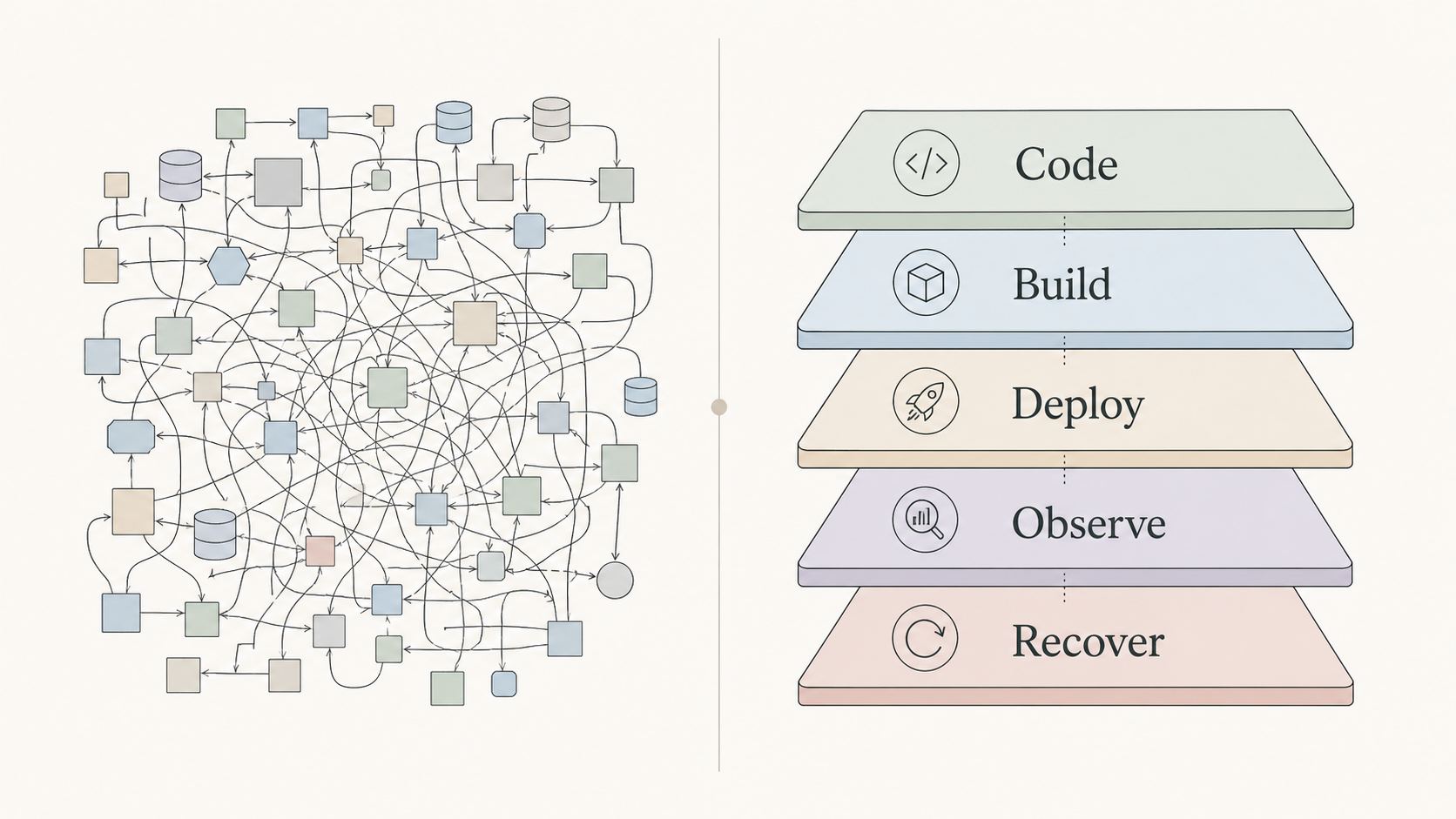
AI-generated diagram. Tools change. Developer constraints do not.
Life Has Slow Variables Too
The same distinction applies to life, though I think it gets more delicate there.
A life can also be built around fast variables: the newest title, the newest aesthetic, the newest purchase, the newest opinion, the newest platform incentive. There is nothing wrong with change. Some change is useful. Some of it is necessary. The problem is when everything keeps changing at the surface and nothing underneath has time to compound.
The slow variables in a life are less exciting to name: health, marriage, craft, useful systems, taste, reputation, friendship, work that compounds, objects that are actually used, a home that supports the life inside it, a body that can carry the life you want, a calendar that reflects what you say matters.
Maybe that is why some versions of status feel calm and others feel anxious. The anxious version has to keep refreshing itself. The calmer version has accumulated enough signal that it does not need to explain everything at once.
Closing Thoughts
Not everything needs to be timeless. Some things should be playful, seasonal, disposable, experimental. There is value in trying on the moment. But it helps to know which layer you are designing.
Maybe the fast variables are where you experiment, and the slow variables are where you compound. Maybe timelessness is not the absence of age. It is recognition that survives change.
So the practical question is not: does this look cool right now?
It is: will this still make sense when the moment disappears?